
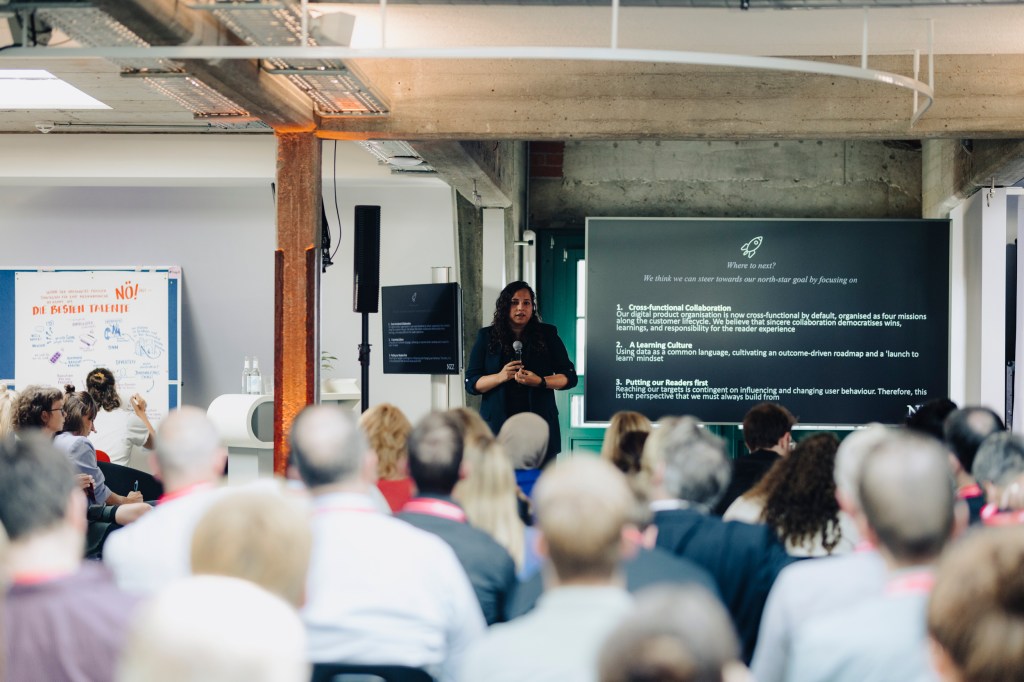
Image credits: ©nextMedia.Hamburg | Laura Müller
2023 was a dinosaur year, professionally speaking. Here are my parting thoughts to this year, and the things I am taking forward into the next one.
I summarise my experience (officially) working in digital product, talk about one of the key factors for success this year, share my learnings on AI, and end with a reflection on work/life balance when it feels like ‘the juggle is real.’ If you choose to visit with these words for a while, I hope they are as useful to you, as this year has been to me.
- Becoming a ‘Product Bro’
My media career started in Digital Product – I just didn’t know it at the time. We called it ‘interactive marketing’ in 2010 and I was part of a team developing mini games, mobile apps, dabbling in augmented reality for marketing activations, and creating a gamified digital content ecosystem. From there my career pivoted to subscriber acquisition marketing and the management of conversion journeys across the customer lifecycle.
Officially stepping back into this sphere this year was a full-circle moment, but it didn’t feel this way at the beginning. I suddenly felt green, wrong-footed which after thirteen years in this industry, was new.
In times of uncertainty, I tend to turn to good books and even better people. Here are my top nonfiction reads of the year:
- Inspired by Marty Cagan
- Empowered by Marty Cagan
- Continuous Discovery Habits by Teresa Torres
- Sprint by Jake Knapp and others
- Competing Against Luck by Clayton M. Christensen
- Immunity to Change by Robert Kegan and Lisa Laskow Lahey
- The Diary of a CEO: The 33 Laws of Business and Life by Steven Bartlett
For the Writers in the room
- A Room of One’s Own by Virgina Woolf
- On Writing by Stephen King
( and for the readers in the room, check out my top fiction of the year here)
I spoke to a lot of kind folks in the product space, played with frameworks and watched and listened to a ton of content. Much of what I found out was both validating and relieving because though the methodologies were new to me, the reasons for them were not, and have informed decisions throughout my career. There is no single golden rule, but I can more or less distil my first year of learning to the following:
- You cannot grow without your customer – growth is intrinsically linked to user behaviour
- In order to influence user behaviour, you must first understand it, validate it, and build the bridge for your customers to behave in a way that achieves your ideal business outcomes
- A change in user behaviour will correspond to changes in your bottom line, do not plan for one without the other
- So build a bunch, test a bunch, steer it towards what makes a better product for users, and help them become better users of your product
Easy, right?
Writing this is me slaying the imposter syndrome dragon that turned out to be a fly in a room I’ve sort of always been in. Opening that window and asking it to (politely) buzz off, was a nice milestone to hit.
- ‘A Rising Tide Lifts Us All’
I am quoting Aliya Itzkowitz at Scoopcamp in Hamburg this year (quoting one of her team who in turn, the internet tells me is quoting John F. Kennedy) This is one of my favourite things about this industry. Externally, this manifests in the readiness of so many industry colleagues to jump on a video call or grab a coffee and talk through a challenge or opportunity, and internally I have spoken at both Scoopcamp and INMA this year about how cross-functionality is a core factor for success. A cross-functional culture is the breeding ground for a learning culture which is a requirement for data centricity which in turn, and most importantly, gives us the best chance for putting our readers first (for why this is important, see 1.)
- ‘The Robots are Here’ …to stay
Ay, yay,yay AI…what a fascinating conversation starter (or ender) this was in 2023. My recommendation for anyone curious about this topic is to do two things. There are a host of free and paid courses from the likes of Google directly, or IBM, Coursera…and many more to help get a baseline understanding of the possibilities and standard definitions in this space. This went a long way in helping me organise my thoughts before acting on what is my second suggestion; spend some time with your friendly neighbourhood data scientist. Here are some of my takeaways from the year, thanks to many conversations, some that I shared at a recent FT Strategies workshop :
- Organisationally, establish ongoing iterative processes to identify, validate, and coordinate AI use cases
- AI projects can very quickly become a home renovation. Can you afford the time to build it? Think of resourcing, technical dependency and organisational focus as key factors in your assessment. Similarly, when evaluating use cases, consider if this will be important in one year, and does this ultimately support your brand value proposition? If your customers won’t use it, don’t even think about it. (Again…see point 1)
- At this early stage, before major upgrades have happened to the services we know and use, start small, focus on what is helpful, and necessary right now and build from here.
- When it comes to data models, remember ‘garbage in, garbage out.’ Watch out for data definitions and ever-changing regulatory considerations
- Consider the impact of your own governance on build implications (eg, what does keeping a human in the loop mean for existing processes and technology?)
Here are also some of the ways I used ChatGPT this year
- It helped me with my German. Especially when I had a question about why phrase X should be used instead of Y. I also used it to practise my German writing skills.
- It wrote all the clues to my family advent chocolate hunt (sorry kids) – and asked it to adapt them when the clues were too easy (not sorry kids)
- It was able to quickly do basic maths from a data set eg. helping me work out everything from travel time, time differences, percentage changes year on year from multiple categories (yes excel can do this too but I had to do 0 formatting, and cell-fiddling)
- It was able to aggregate how much butter and sugar I needed to buy from a stack of holiday recipes…the answer to this I will take to my grave.
What strikes me about this list is, (bearing in mind this is a sample size of one, and limited to my intuitiveness with the app), there were so many every-day use cases that had me reaching for it that really should make anyone in any consumer space sit up. It was helpful, intuitive and easy to use. Ignoring all the noise around generative AI, it’s this reason that I think the kinks will be worked out and regulation will find its feet because before long this level of ease and utility will become a consumer expectation.
- Boundaries vs Balance
The poetry open-mic night I co-founded eighteen years ago in Hong Kong is still going strong. I am proud of this. I am also incredibly proud of my two teenagers, the first book I wrote, the poems I still write today, and the other hobbies and interests I have gained over the years. I like what I do for a living, spending time with people as much as I like to ignore them to spend time with books, and the interplay of all of these things in my life.
My parenting made me a better poet, my poetry made me a better communicator at work.These are unalienable self-truths – I don’t make the rules, this is just how it panned out.
Over the years, colleagues and friends have asked me about balance, any habits or tricks to share about the optimal way to set up your life to maintain equilibrium. I am not sure what I said before, but sixteen years into this juggle this is what I know. It was never about balance. Balance denotes equality, and a rigid adherence to maintain it. It was also never about having it all, which incidentally you CAN have, just not at the same time.
For me, at least, it really was about setting up boundaries vs balance. Balance could be an outcome of this, sure, but boundaries were promises I made to myself. Boundaries acknowledged what was important to me, and allowed me to plan my attention as fluidly as a busy family life will dictate. This does not mean there is no discipline that goes into it. For instance, I take my reading goal for the year as seriously as my professional goals.
Am I suggesting everyone have kids and write poems? Goodness, no. I am just saying that there are things that are complementary to your skillset that are not necessarily derived from or restricted to one area of your life. Work skills are not just for work and life skills are not just for your personal life. It all matters, and creating space for what mattered to me allowed the best of all worlds to come together.
 Nashua Gallagher