
How did I do this year?

🎉 On target
🙌🏽 15 non-fiction (I was aiming for ten)
🤷🏽♀️ 3 / 12 poetry collections
🇩🇪 0 / 2 books in German ( I read a lot of my news in German instead)
2025 Book Lists
My favourite thing about these lists is that I don’t even know what will make the cut until I compile them. First impressions change, and things shift in the context of the whole year once memory joins the fray. There are several honourable mentions I have ommited, but if I change my mind (and you’d like these reviews in real time) follow me here.
- Fiction
- Non-Fiction
- Biggest Book Hangover
- Fantasy
- Got Out of a Reading Slump
- Standing Ovations I Didn’t Join
- Wine & Vinegar (best and worst re-reads of the year)
Just want the lists, no blah blah? Click here for the stipped down view.
Fiction
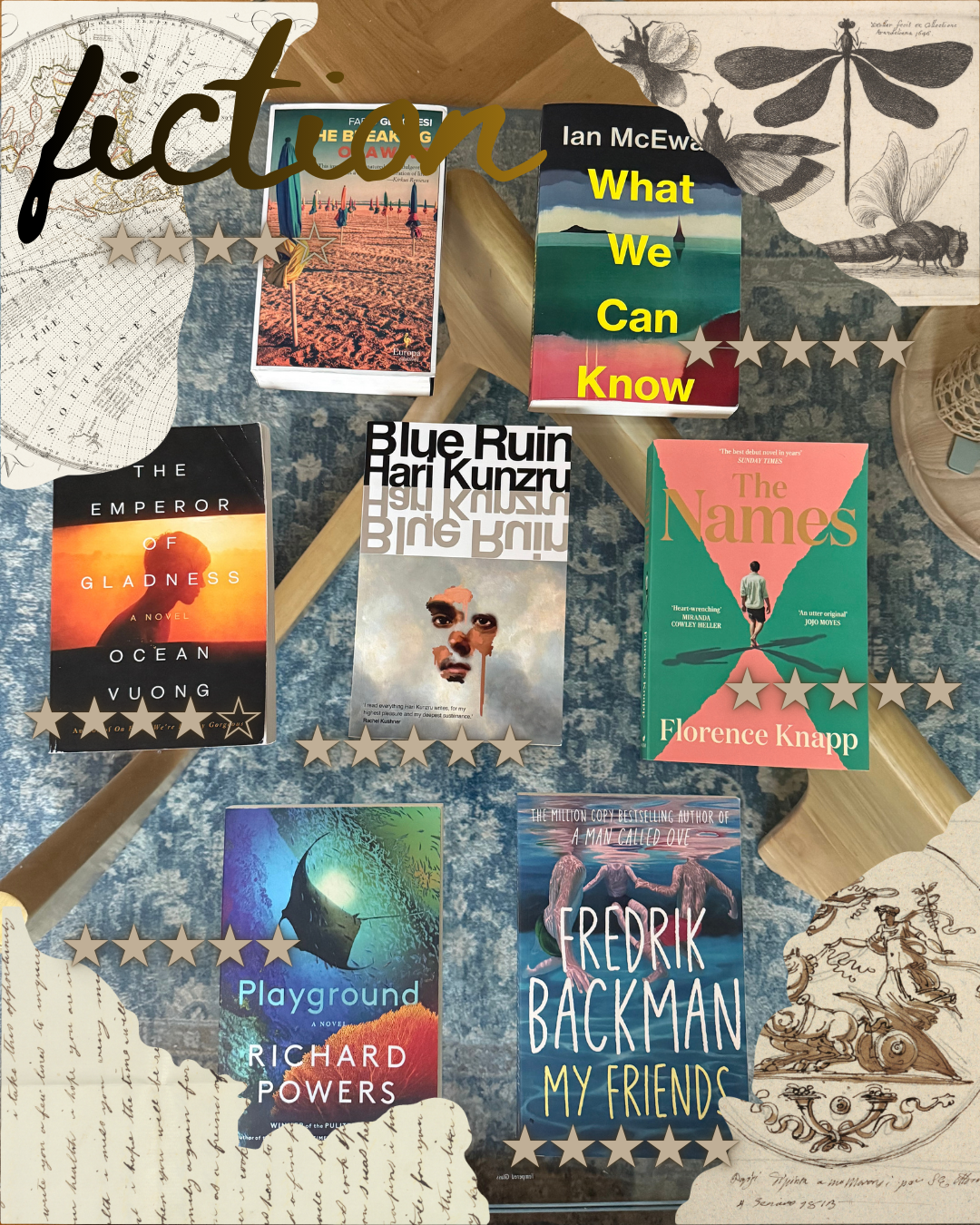
What We Can Know by Ian McEwan | ★★★★★
This book fed me for days, its character changing with the pages but narrative like a structural beam throughout the book. I created wrinkles in this book’s spine for all the notes I added to its margins >>>
That it touched on the lives of esteemed and therefore crotchety poetry types was a bonus. I sniggered at what I recognised and was moved by the emotional resonance as characters were revealed. Absolutely everyone is marvellously, morally grey in this book. I texted a friend halfway, ‘it’s maddening – he writes with such lucidity and nuance, I can’t imagine [one of his contemporaries] writing about AI and geopolitical disaster with this sort of alacrity.’
One of its themes are the prisons we create for ourselves – whether built or assumed. The way this is relayed in the second part of the book should be studied.
I think of it as a sister-read of «Atonement» in how it explores revisionist history, curative narratives, the sleight of hand that is memory. There is irony and caricaturing so subtle it’s practically cheeky, but intentional as is always with McEwan – there is no loop left unclosed. He practices prose with the deliberateness of poetry.
There’s even some mild futuristic sci-fi and a touch of virtue-extolling, some geopolitical doomsdaying. Its sharp but also snaps back into the delicacy and ease of an English cottage garden. It’s also inexplicably only 300 pages long.
I don’t want to tell you anything about the plot. Go read it, and let’s chat over voicenotes or with takeaway coffee with our heels disturbing autumnal mulch. A perfect late-year read.
My Friends by Fredrik Backman | ★★★★★
I was the crazy lady at the beach who would pause her reading at the turn of a phrase to clutch my novel to my chest and stare into the blue void. >>>
Reading this book oddly seems to attract sand in your eyes. My teenagers were mortified. Friendship, grief and belonging is captured in a way that slows time and turns pages.
There was one part that snagged at me, in an otherwise straightforward novel. One of our protagonists is an artist who paints from pain and compulsion, or boredom or catharsis or any other reason than the accolades and fame which he goes on to achieve. The plot opens with him encountering someone who is wired the same way.
As a poet that writes to encapsulate and occasionally platform a thought or a moment, my motivation (flagged, faded and life-worn) tends to be the process itself. But still, there are moments. When folk connect to one of my pieces, or see the wiring for what it is, or light up at the same things. (Not often, not regularly – it IS still poetry for goodness sake.) It has made me feel like the luckiest, most useful person on the planet. It’s only a moment, it’s fleeting, but it’s everything. This feeling was glittered across this novel. It made me ache, it made me smile. It made me want to write again.
There’s so much love in all its forms it’s actually a little rude to be made to work so hard and feel so much just to try and read a book on holiday.
I would not recommend this book to everyone, but I would to people I truly love. For anyone who feels like one of us.
Anyway, at this point I would read Fredrik Backman’s discarded grocery lists. Perhaps after I’m done with German I will try and tackle Swedish.
Playground by Richard Powers | ★★★★★
TLDR: A masterpiece on the precipice humanity finds itself, concerning the future of our oceans and AI (yes, really) >>>
In 1947 a little girl is pushed into a swimming pool with an early prototype of an aqualung – taking her first breaths towards becoming a marine biology legend. Two teenagers in Chicago’s fierce love and competition with each other heralds their undoing. Deep-learning algorithms transform social networking and change the way humans relate and play and an island in French Polynesia must decide their fate.
This book is an urgent, contemporary, gasp-out-loud read. Themes: adolescence, friendship, found-family. Features marine life so gorgeously recounted it reads like magical realism.
Manages to be cautionary without being preachy and lends itself to broad interpretation.
Leaves you with hope.
The Emperor of Gladness by Ocean Vuong | ★★★★☆
19 year old Hai is about to jump off a bridge and is stopped by Granzia, an elderly widow with dementia who convinces him to become her caretaker. >>>
- Backdrop Fictional rural Connecticut
- Themes unlikely friendship, grief, poverty, drug abuse, immigration, mental illness
- You might like this if you liked ‘Demon Copperhead’, found family, quirky characters, visceral, poetic prose
- You might NOT like this if ambiguous endings, drug abuse, and stories of abandonment are not to your taste
- Verdict I loved it. Vuong’s writing cradles these characters in their hope and humour, gritty desperate love in all forms. They will stay with you.
Blue Ruin by Hari Kunzu | ★★★★★
What would you do if you end up delivering groceries to an ex you haven’t seen in a few casual decades? This is no meet-cute, but a nosedive into the scabbed up parts of a complicated adolescence with a loose promise of breaking the surface on middle-aged closure. >>>
- Destructive, formative love
- a timeline that traces artists, art, freedom and betrayal
- from fug and grime of the 90s to sanitised inequality of pandemic 2020
- is ironic, somehow lightly comedic with a stinging pathos
The Breaking of a Wave by Fabio Genovesi, Will Schutt (T) | ★★★★☆
If Wes Anderson made a movie about grief, it would be this novel set in a quiet Italian coastal town. Change rips through Luna’s world, making flotsam and seafoam of everything she knows >>>
Already ridden with papercuts for being a little different in the ricepaper veil between childhood and adolescence – the loss of her brother, the diminishing presence of her mother, and the small-town stigma sets salt into what already hurts.
Luna befriends Zot, a transplant from Chernobyl and the two children pull you into lands of make believe, clear-eyed child logic and light scheming. There are a cast of complementary characters, flawed, hilarious, despicable and kind. I picked this book up in Rome in the Spring, and ear-marked it as a summer read. Some reviews criticise the pacing, it’s slow to pick up all the oddballs on the way but this is precisely what makes it such a great sprawling summer read. It was touching, witty and delicately relayed. I can only imagine how good it reads in the original Italian.
The Names by Florence Knapp | ★★★★★
I’m always impressed with authors that can tell by showing >>>
There are difficult, inked-in scenes of domestic violence in this book handled with a frankness that still leaves room for empathy. It is somehow still gentle, a vignette of humanity, as delicate and complex as the butterfly wings that sets these stories in motion.
Gordon, Julian, Bear.
Three names for the same boy whose identity, relationships and destiny flex around the circumstances of his name. This book had me racing, savouring, and thinking about amongst other things – ‘what’s in a name?’ Definitely one of the best of the year so far.
Non-Fiction
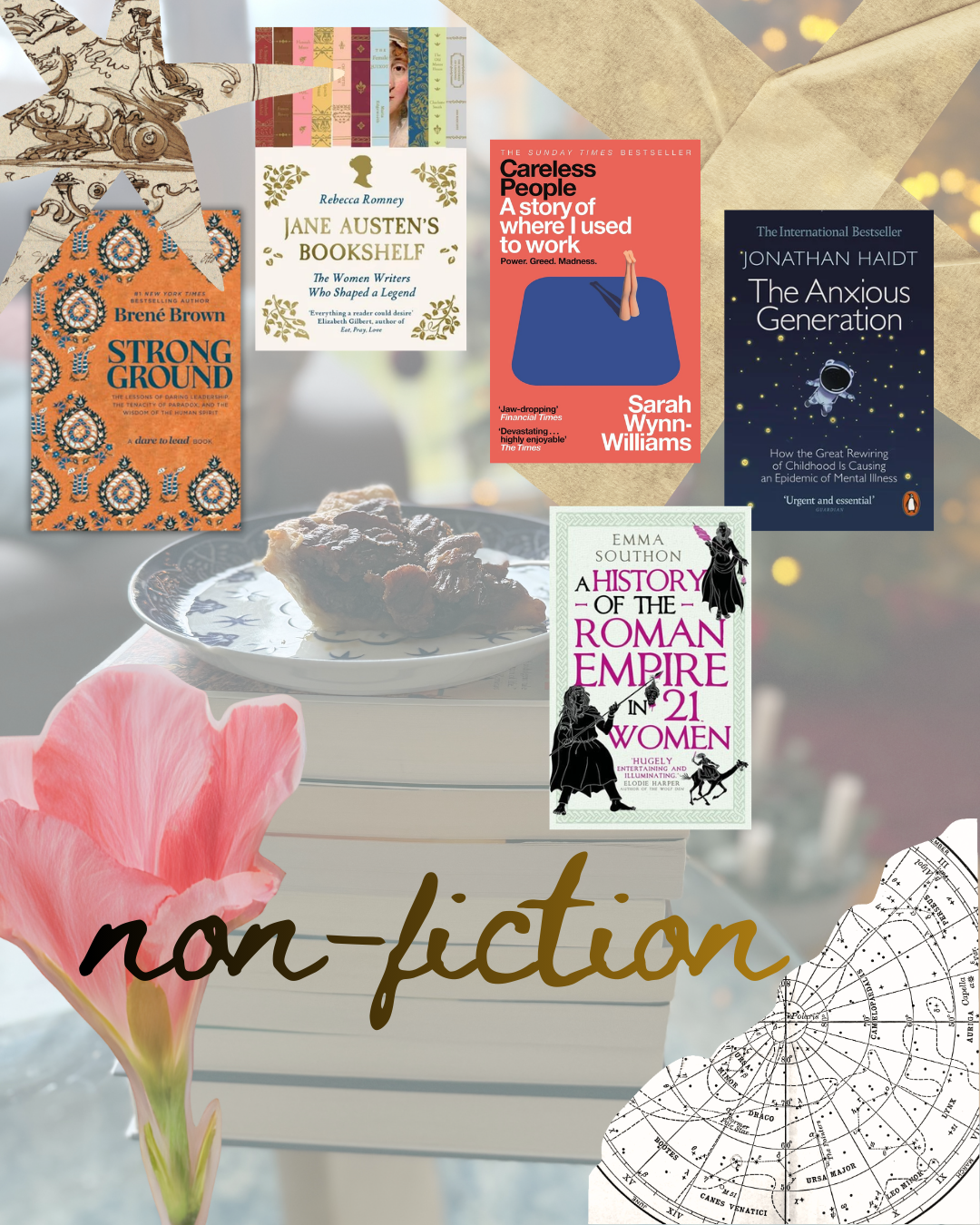
Jane Austen’s Bookshelf: The Women Writers who Shaped a Legend by Rebecca Romney | ★★★★★
Shelf trophy pending as I listened to this one. I assumed it was going to be a rather straightforward take on the literary influences of Jane Austen.
What I didn’t expect was this to become a sort of «Invisible Women», (Caroline Criado Perez) of literary feminist history. It has all the academic spirit and wry observation of «The Thing About Austen» podcast plus historical context of women writers, like an 18th century lens to «A Room of One‘s Own.»
I learnt about the world of rare books and was hooked by the hunt of certain editions – the stories of the books adding richness and texture along the way. I may not read all of the books covered here but their backstories and the lives of the authors made this an intriguing, gem of a book.
Standing Ground by Brené Brown | ★★★★☆
A compilation of leadership wisdom on how to role model and exemplify grounded confidence, vulnerability and authenticity. Does Brown even need an introduction?
Careless People: A Cautionary Tale of Power, Greed and Lost Idealism | ★★★★☆
For all the mixed reviews, I delighted in this salacious account. It is undeniably a sign of our times that tech memoirs are starting to read like rockstar memoirs. As someone who was totally taken in by both «Lean In» and «Option B», this led to interesting conversations with friends about privilege and narrative. Somehow both highly entertaining and sobering, leading to a higher rating that I would have thought.
A History of the Roman Empire in 21 Women by Emma Southorn | ★★★☆☆
A solid little read, exactly as described on the tin. I love looking at a well documented picture from a different angle and this is what this book delivers with great humour and interest.
The Anxious Generation by Jonathan Haidt | ★★★★☆
Spoiler: kids are chronically oversupervised in the real world, and disturbingly undersupervised in the online world. Kids also should not have access to social media. Every parent and educator should read this book, but I would say its relevance extends beyond caregiving. The implications beg us to consider what cultural norms do we want to uphold as a society. A good one for discussion.
Biggest Book Hangover
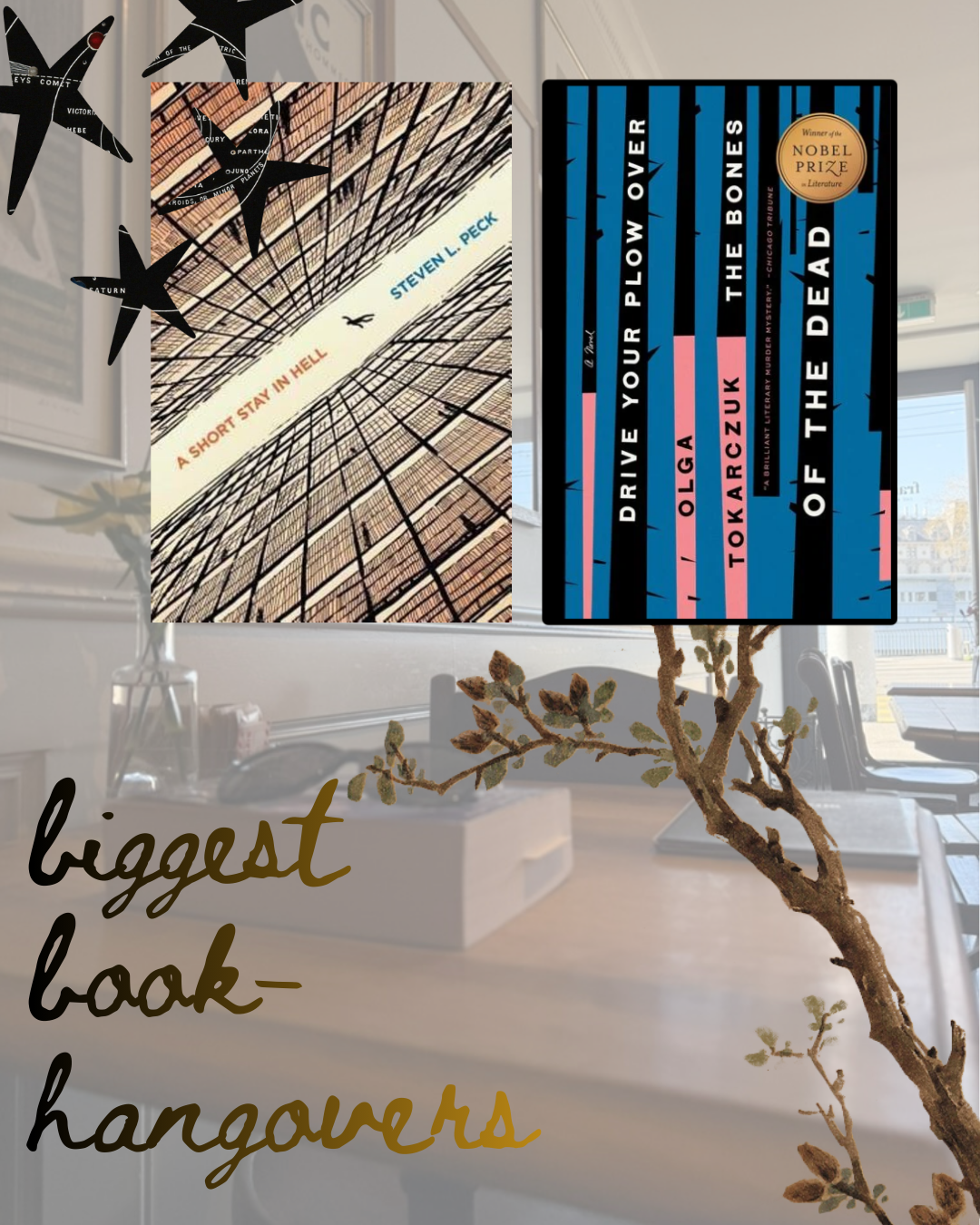
A Short Stay in Hell by Steven L. Peck | ★★★★☆
Drive Your Plow Over the Bones of the Dead by Olga Tokarczuk | ★★★☆☆
I came to both books with little context, and you should too. One involves somebody making it to hell. The other is of a Polish woman who lives in a remote community in the the woods.
Both are exceptionally short, but stayed with me for days compared with more wordy counterparts.
Fantasy
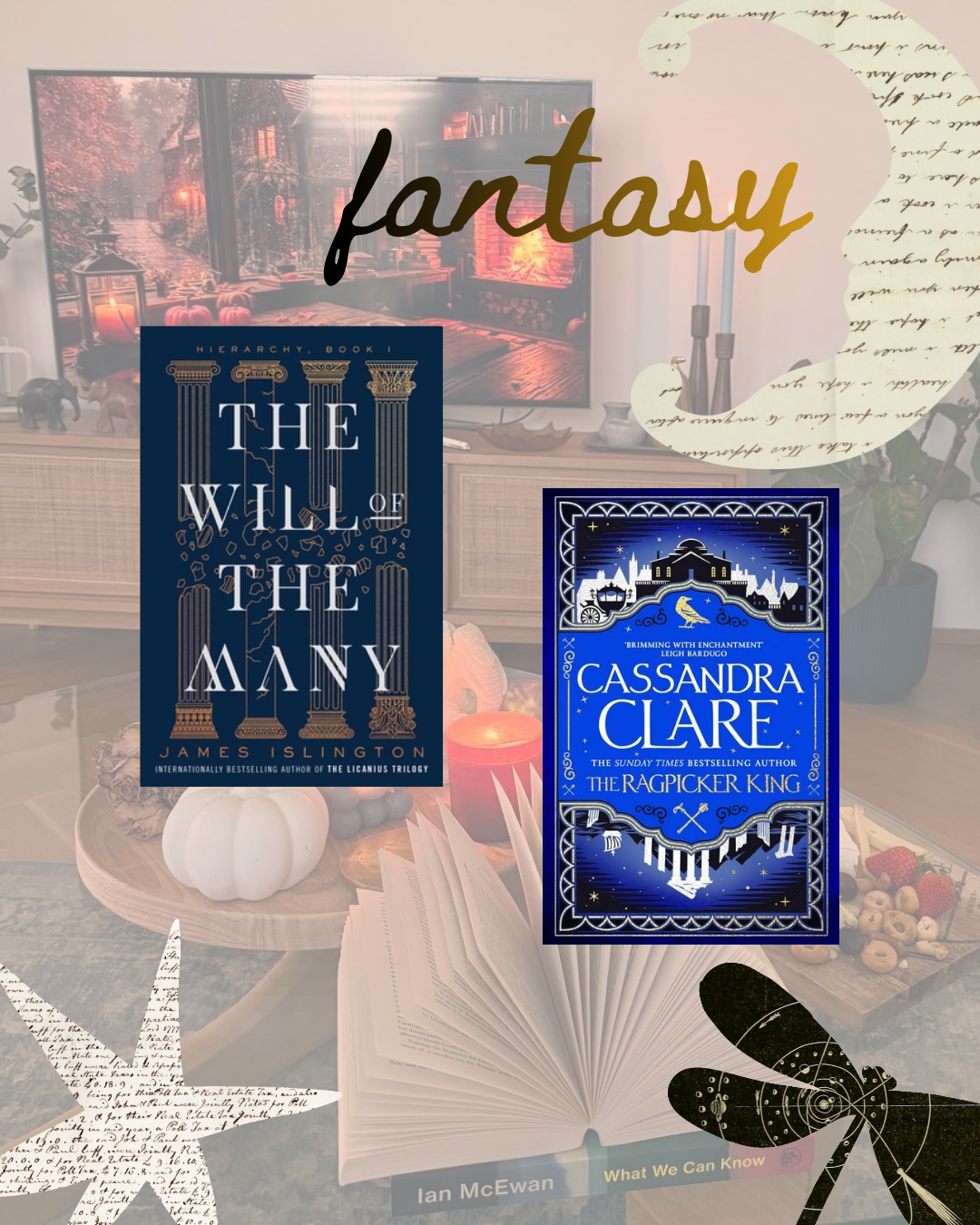
The Hierarchy Series by James Islington | ★★★★★
Rotting Gods that was good. Obscene levels of immersive world building. I couldn’t explain the wild specificity of this fantasy-sci-mytho-thriller if I tried. A sprawling masterpiece that is a credit to the genre. Do we actually need another school of magic with a light «Hunger Games» bend? Good god yes. I am beside myself in anticipation of the sequel which will be one of my first read in 2026.
The Chronicles of Castellane Series by Cassandra Clare | ★★★★/★
No notes. Both «Sword Catcher» and «Ragpicker King» were a symphony of enriched world-building, intrigue and exactly what you want in a high fantasy series. No publish date specified for the third book….which is fine…
Got Out of a Reading Slump
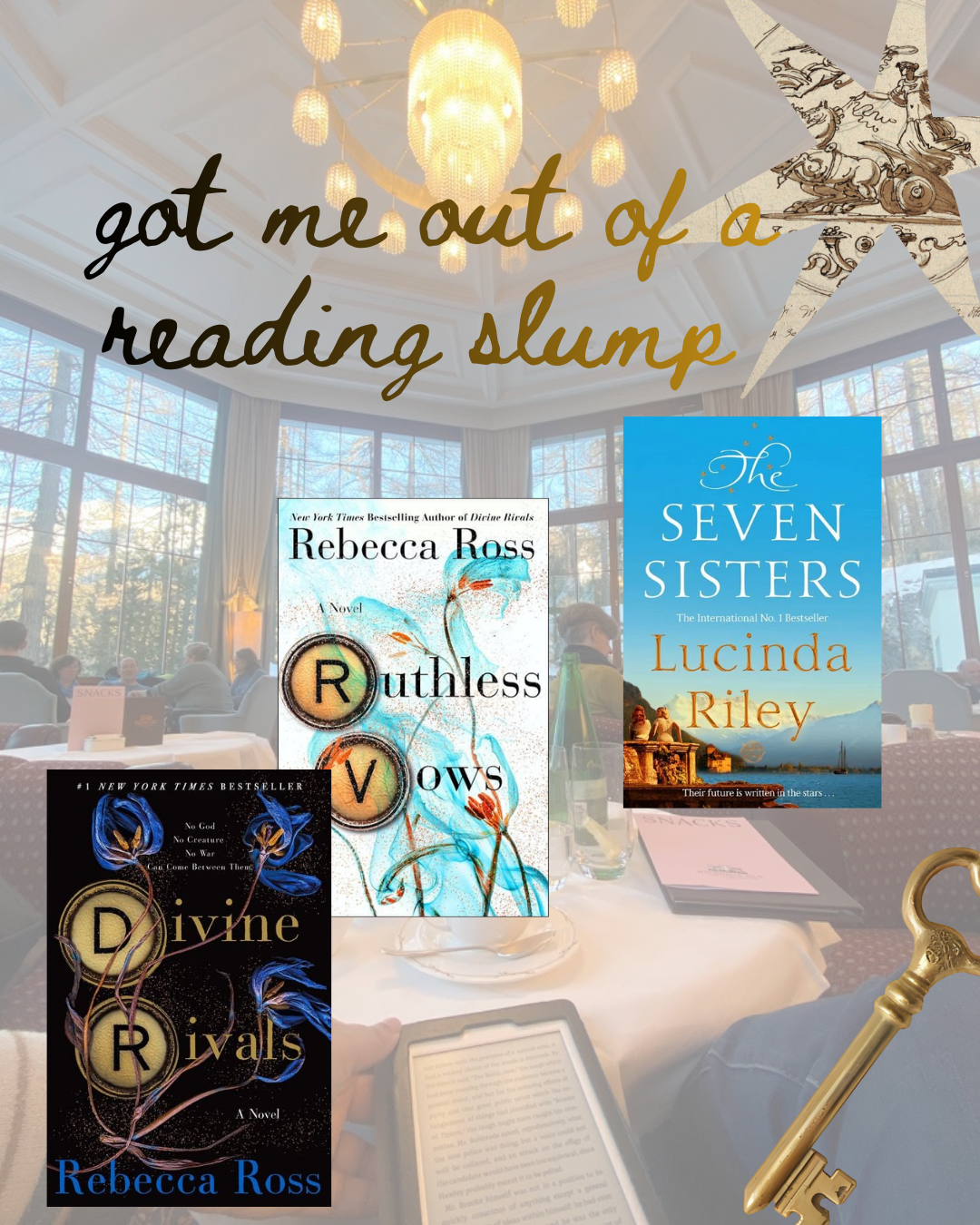
Divine Rivals & Ruthless Vows by Rebecca Ross | ★★★☆☆
You’ve Got Mail – but make it a romantasy with typewriters and throw in a war.
7 Sisters Series by Lucinda Riley | ★★★/★☆
These books are MASSIVE, but you get three for the price of one. First the story of the modern day sister, then the historical-fiction narration of their ancestor, and finally whatever the meta-plot is that threads all seven books together. The premise is imaginative, flirts hard enough with reality to make you believe for the duration of the novel, and before you can question too much, takes you deep into whatever country and era each protagonist descends from. It is simply a wildly entertaining ride. I have read four so far, and am spacing them out because they work so beautifully as reading un-slumpers.
Standing Ovations I Didn’t Join
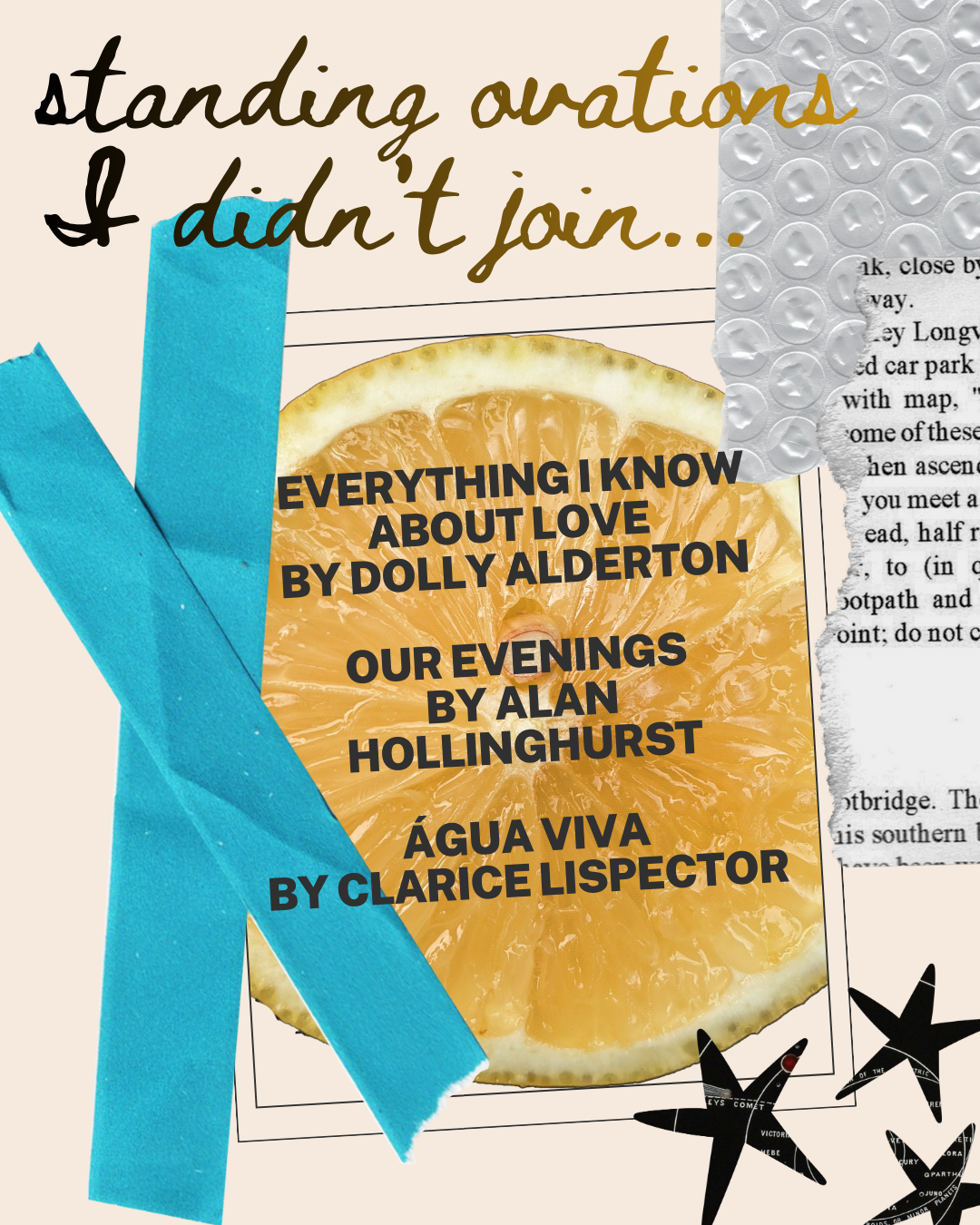
Água Viva by Clarice Lispector | ★★☆☆☆
‘To live life is more an indirect remembering than a direct living’ It’s blazes of insight like this that contributed to its second star. I trust the fault here is with this reader. I knew this was a novella – praised for being hypnotic, abstract yet lucid. A delight for logophiles across generations. Sadly, for me at least, the journey was more pain than paean. >>>
- 11% intriguing, a painter uses stream of consciousness as the medium to subsume art forms. Innovative and hazy water colour trails of thought with occasional beams of clarity. I’m curious.
- 14% I am no longer curious, yet stubbornly hopeful for ‘stream of consciousness’ to represent something transcendent, but I can never seem to get on this train. Not for ‘Walden’ or ‘No One is Talking About This’ or ‘Checkout-19.’ My own thoughts sound preachy, I’d rather not drown in anyone else’s puddle.
- 16% maybe I’m just an experimental format snob. How disappointing for a freeverse millennial poet.
- 18% Would I like this more if it were an actual poem?
- 21% No.
- 22% Despite certain luminous turns of phrases, and multiple highlighted passages, it now feels more appropriative of poetry, than poetic
- 42% It’s a very bad sign that Ulysses just popped into my mind
- 46% ‘All living beings, except man, are a scandal of astonishment’ its like squid-fishing at night for writing prompts. There, now I’m doing it too.
- 48% ‘I notice I’m writing as if I were between sleep and wakefulness’ – literally, just NOW?
- 61% ooh, I like this bit about flowers
- Rest of the book – I’m going to finish this in one sitting. Like being on day three of a holiday and realising, OK, this place isn’t for me but let’s make the best of it.
The next time I put a ‘stream-of-consciousness’ read on my ‘to read’ list please check in on me.
Our Evenings by Alan Hollinghurst | ★★☆☆☆
Oof. The blurb and the novel seemed to have missed each other. An excruciating 486 pages where any hope of a plot is abandoned for a heavily redacted diary of sorts of an ok, somewhat dull sort of man living through interesting times. >>>
Given the premise – a queer, mixed-race man spanning Thatcher‘s Britain to 2020, there should have been an interesting perspective, but the writing was so busy othering the protagonist that the reader easily misses most of the story.
The time jumps are disorientating and any hoped-for identity-affirming plot is distorted by a rather horrifying Paddington-bear-esque ‘fist-out-of-water’ dialogue.
The theatre references were suffocating.
Although the pacing of the first part of the novel gently affixes a lavender haze of adolescence and becoming, it unravelled in a sprawling, exhausting way that makes the reader forget to hate the rather forgettable antagonist. Had hoped this would be Julian Barnes or Ian McEwan coded. I tried very hard to like it.
Everything I know about Love by Dolly Alderton | ★★☆☆☆
This was not the one for me. Nostalgia, humour and the celebration of girlhood / friendship aside (although halfway through this book I did think that if she were my friend I’d ask her to sign an NDA if we so much as went to the loo together, let alone a girls’ trip.) Contrary to the tone of this review, I tried really hard to like this one, and am firmly in the minority when I say…ugh >>>
The memoir format possibly had this on the backfoot from the start – would it have felt as jarring if it were a podcast or a work of fiction? It had a messy SATC undertone that prods in the direction of columnist gone rogue. The satirical emails, tongue-in cheek lists and recipes added to the noise – it was all over the place, and maybe this was a storytelling device but it somehow diluted the writer as she diligently and distractedly opened bag after bag of tricks. An anecdote here, some self-deprication there. The final straw that murdered the camel were the timeline inconsistencies and eye-smarting negative exceptionalism. 2.5 stars.
Wine & Vinegar
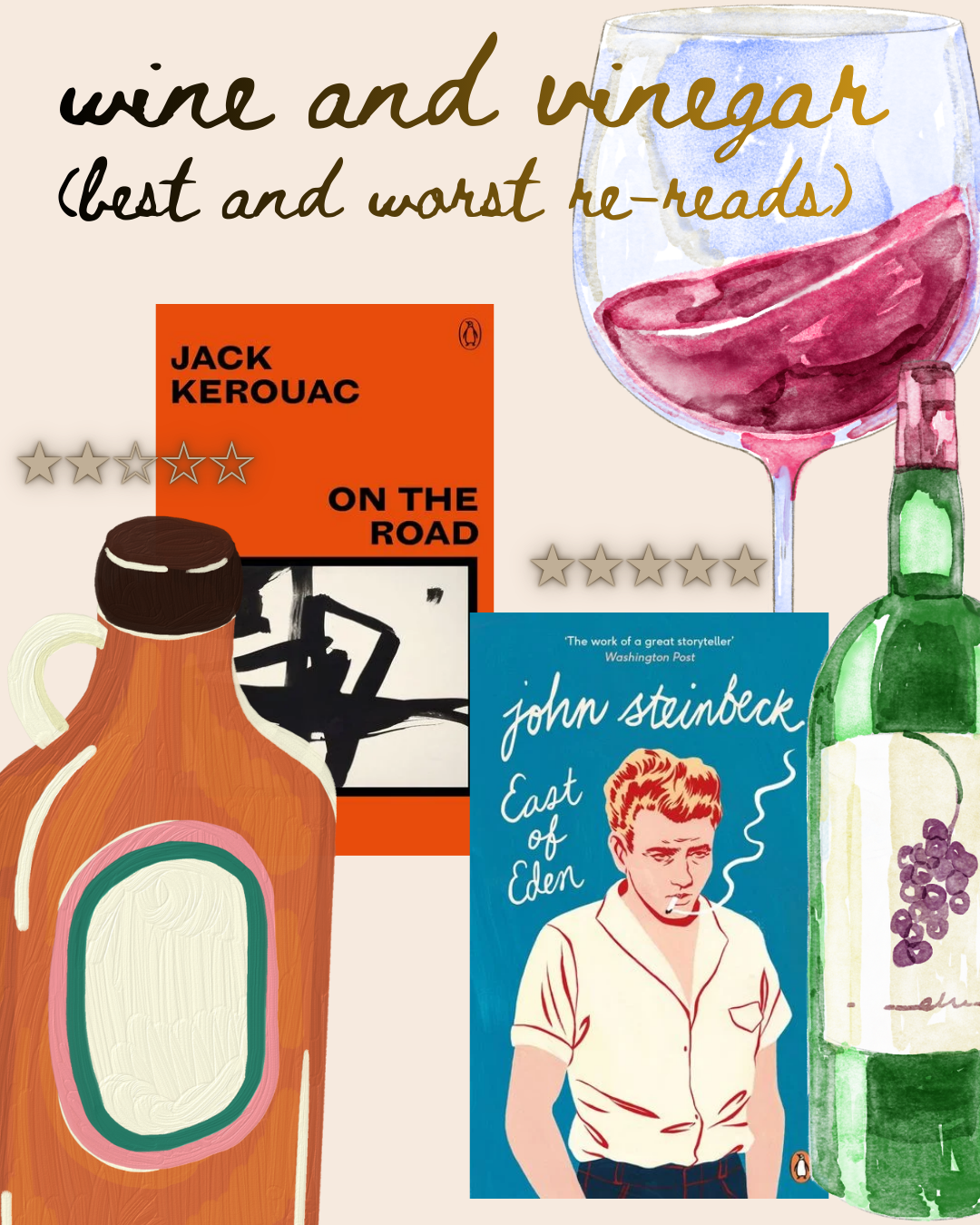
On the Road by Jack Kerouac | ★★☆☆☆
Read this when I was 16, and again at 36. Twenty years for a star to drop from my rating. This book has one of my all-time favourite lines in it, and though I took care to not impose modern gaze, pacing or cultural bias – it was just OK.
Not as salacious as memory served, and not the seminal read to connect to the wild and ruinous madness of the literati (which is why I picked it up as a young poet, aching to glimpse something affirming.) Characters display eye-watering levels of narcissism, just shy of irony nevertheless softly redemptive as a stand-apart piece of canon. Will give this one a wide berth, and don’t think I’ll be picking it up again in another 20 years.
East of Eden by John Steinbeck | ★★★★★
A yarning, sprawling, wordling genius of a book. I don’t know how it manages to incorporate so much additional allegory and backstory (things that could detract and muddle the point of it all) and then bullseye the ending so well. It’s
Cain and Abel, but also a contemporary American immigrant story. It’s blisteringly human, flawed, interesting and quietly ironic. The writing is achingly wise and startling turns of phrase thrum every few pages. I didn’t bother annotating because all of it is so good. I’m tempted to read it for the third time just to see how much of it gets highlighted.
If you need a book to just spend time with, this is the one. It’s definitely becoming one of my favourite reads of all time.
Just the list, please!
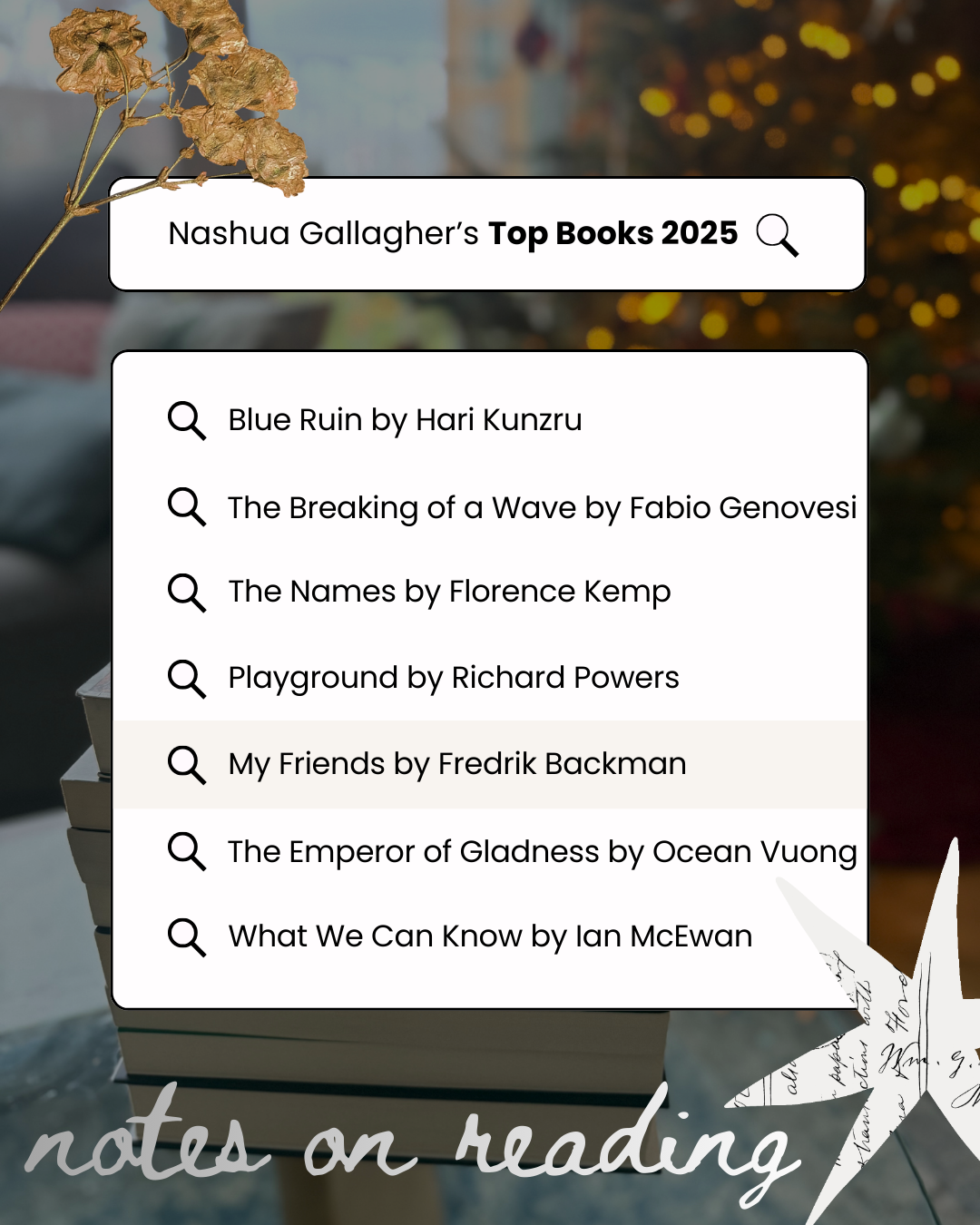
Fiction
- What We Can Know by Ian McEwan | ★★★★★
- My Friends by Fredrik Backman | ★★★★★
- The Names by Florence Kemp | ★★★★★
- Playground by Richard Powers | ★★★★★
- The Emperor of Gladness by Ocean Vuong | ★★★★☆
- Blue Ruin by Hari Kunzru | ★★★★★
Non-Fiction
- Jane Austen’s Bookshelf by Rebecca Romney | ★★★★★
- Standing Ground by Brené Brown | ★★★★☆
- Careless People by Sarah Wynn-Williams | ★★★★☆
- A History of the Roman Empire in 21 Women by Emma Southorn | ★★★☆☆
- The Anxious Generation by Jonathan Haidt | ★★★★☆
Biggest Book Hangover
- A Short Stay in Hell by Steven L. Peck | ★★★★☆
- Drive Your Plow Over the Bones of the Dead by Olga Tokarczuk | ★★★☆☆
Fantasy Series
- The Hierarchy Series by James Islington | ★★★★★
- The Chronicles of Castellane Series by Cassandra Clare | ★★★★/★
Got Me Out of a Reading Slump
- Divine Rivals & Ruthless Vows by Rebecca Ross | ★★★☆☆
- 7 Sisters Series by Lucinda Riley | ★★★★★
Standing Ovations I Didn’t Join
- Everything I know About Love by Dolly Alderton | ★★☆☆☆
- Our Evenings by Alan Hollinghurst | ★★☆☆☆
- Água Viva by Clarice Lispector | ★★☆☆☆
Wine & Vinegar (Best and worst re-reads)
- East of Eden by John Steinbeck | ★★★★★
- On the Road by Jack Kerouac | ★★☆☆☆
FIN. See you next year!
 Nashua Gallagher